
Overview
- Debt management begins with breaking the hidden cycle of borrowing from next month's income to cover this month's necessities.
- Relying on a single checking account creates a misleading picture of your money, making it easy to spend cash that is already committed to upcoming bills.
- Moving your money into dedicated bank accounts separates your fixed living costs from your everyday spending, protecting essential bill money from accidental card swipes.
- By combining structured bank accounts with clear spending boundaries, you can permanently escape the credit card float and achieve lasting financial wellness.
On paper, your finances look under control. Your credit card bill arrives, you transfer the money, and your statement balance drops to zero. You dodge the interest charges, keep your credit score intact, and collect your rewards points.
Then Monday morning hits.
Your checking account is drained down to double digits, the next paycheck is twelve days away, and the fridge is empty. Within forty-eight hours, the credit card is back in your hand for groceries, gas, and a utility bill.
This is the credit card float—a quiet trap where you spend your entire paycheck paying for last month’s life, leaving nothing behind to fund this month’s necessities. It is not a failure of discipline or a lack of hard work. It is a mechanical timing flaw in your bank accounts.
This guide shows you how to fix that timing issue for good. By setting up dedicated bank accounts, you can separate your bills from daily spending, protect your cash, and build genuine financial wellness without running on empty.
That exhausting cycle is not a sign of failure, nor does it mean you are bad with money. It simply means you are caught in what financial experts call the credit card float. You are working hard, making your payments, and trying your best to do everything right. Yet, because your entire paycheck vanishes into last month’s credit card bill, you are left with zero cash to pay for today’s essentials.
This guide will show you how to step off that exhausting treadmill for good. By organizing your money into dedicated bank accounts, you can build clear financial boundaries, protect your paycheck, and transform your personal finance routine into a source of peace and stability.
How Dedicated Accounts Restore Financial Wellness
What Is the Credit Card Payoff Loop?
The credit card payoff loop happens when your living expenses and your debt payments compete for the same pool of cash.
Each month, you charge daily necessities like fuel, groceries, and utilities to your credit card. When your paycheck arrives, you use most or all of it to pay off that statement balance. That payment feels great for a moment. But within days, your checking account is empty, leaving you with no other choice than to put your daily expenses right back onto the card.
Even if you pay off the balance every single month without paying interest, you are still living on money you have not yet earned. The real danger occurs when an unexpected expense hits. It could be a medical copay or a car repair. Because you have no cash buffer, that surprise expense immediately turns into high-interest debt, making effective debt management feel like an uphill battle.
The Psychology of Spending: Why One Account Sets You Up to Fail
Most people try to solve this problem with strict willpower, but our brains are simply not wired to budget out of a single checking account.
When all your income sits in one balance, it creates an illusion of extra cash. You might check your bank app, see $3,000, and feel comfortable spending $150 on dinner with friends. What you cannot see in that single number is that $2,500 of that cash is already spoken for by your upcoming rent, electric bill, and insurance premiums.
At the same time, swiping a credit card dulls the natural friction of spending. When you hand over paper cash, you physically feel the loss as your wallet empties. When you tap a card or pay online, that sensation disappears. The bill is delayed for weeks, which makes spending feel completely painless in the moment. To break the loop, we have to replace mental math with physical account boundaries.
How Profit First Accounting Principles Protect Your Cash
In business management, a proven methodology called profit first accounting teaches owners to split incoming revenue across separate bank accounts before spending anything on operating costs. Instead of hoping money is left over at the end of the month, the system secures the most important goals first.
You can apply the very same principle to your household personal finance. By automatically sorting your income into purposeful bank accounts the moment payday arrives, your bills are covered before you ever make a discretionary purchase.
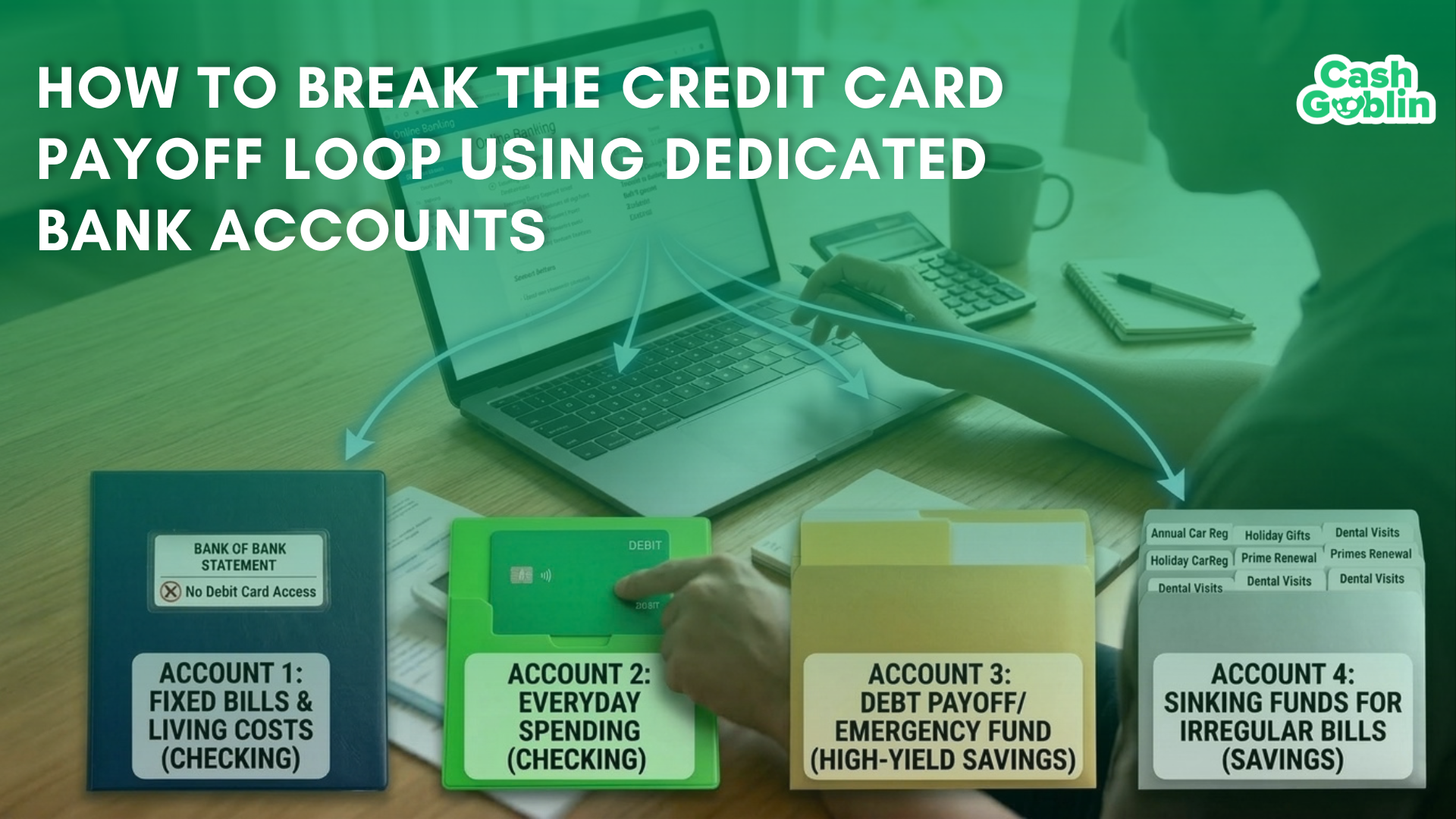
The Four Core Accounts for Lasting Personal Finance Success
Account 1: Fixed Bills and Living Costs (Checking)
This account serves as the protected home for all your predictable, recurring survival expenses. Rent, mortgage, utilities, car payments, insurance, and regular debt minimums belong here.
- The Rule: Never carry a debit card for this account in your wallet. All payments from this account must flow through automated online bill pay or direct bank debits. This ensures your vital living expenses are completely safe from impulsive shopping.
Account 2: Everyday Discretionary Spending (Checking)
This is your guilt-free, day-to-day spending hub. It holds your flexible weekly allowance for groceries, gas, takeout, clothing, and entertainment.
- The Rule: This is the only debit card you keep in your wallet or connect to mobile pay. When the balance in this account reaches zero, spending stops until the next deposit. Because your bills are already protected in Account 1, running out of spending money is an inconvenience, not a financial emergency.
Account 3: Debt Payoff Buffer and Emergency Fund (High-Yield Savings)
This account acts as your financial shock absorber. During your transition away from credit cards, it supplies the safety cash you need to handle unexpected hiccups without turning back to plastic. Once you are free of the credit card loop, this account grows into a true emergency fund covering one to three months of living expenses.
Account 4: Sinking Funds for Irregular Bills (Savings or Sub-Accounts)
Unplanned expenses are often just predictable bills that arrive irregularly. Annual car registrations, holiday gifts, Amazon Prime renewals, and routine dental visits happen every year, yet they regularly catch people off guard. Setting up a dedicated savings bucket lets you set aside small, manageable amounts each month so you can pay for these events with cash instead of credit.
Step-by-Step Debt Management: Transitioning Off the Float
- Open your dedicated accounts: Choose a bank or credit union that charges zero monthly maintenance fees.
- Opt out of overdraft coverage on your spending account: Under federal banking rules (Regulation E), banks cannot charge you fees on everyday debit purchases unless you opt in. By staying opted out, a purchase that exceeds your spending balance simply declines with zero fees, giving you an immediate, cost-free boundary.
- Automate your payroll direct deposit: Ask your employer's payroll department to split your deposit. Send the exact dollar amount needed for your fixed monthly bills into Account 1, send your flexible spending money into Account 2, and route any extra toward your debt payoff buffer in Account 3.
- Bridge the cash-flow gap: To stop charging new expenses to your credit card immediately, pay only the minimum due on the card for one cycle while using your current paycheck cash to fund Account 1 and Account 2. Once your daily living is fully supported by cash, attack that frozen credit card balance with focused, intentional payments.
- Add friction to credit card use: Remove your credit card numbers from autofill on your phone and internet browser, and delete them from shopping apps. Put the physical cards away in a safe spot so you default to your spending debit card for daily life.
Frequently Asked Questions
How do dedicated bank accounts improve debt management?
Dedicated accounts separate your committed bill money from day-to-day spending money. This structure keeps you from accidentally spending cash meant for fixed bills and debt payments, making your monthly budget predictable and automated.
Will I be hit with overdraft fees on my new debit card?
No, as long as you do not opt into overdraft coverage. Under federal rules, your bank will simply decline point-of-sale debit purchases if funds are insufficient, preventing costly overdraft fees entirely.
How does profit first accounting relate to personal finance?
Profit first accounting prioritizes essential targets before paying operating expenses. In personal finance, this means funding your emergency savings, debt reduction, and essential bills first, leaving whatever remains for discretionary lifestyle spending.
What is the fastest way to break the credit card float?
The fastest way is to temporarily pay only the card's minimum balance. This immediately frees up your current paycheck to cover ongoing living expenses with cash, breaking reliance on the card.
The Bottom Line: Your Path to Financial Wellness
Getting trapped in the credit card payoff loop is not a personal failure—it is simply a mechanical flaw in how money moves through your household. When your bills, everyday spending, and savings all sit in a single account, it is almost impossible to keep them from bumping into one another.
By building a system of dedicated accounts, you take the pressure off your daily willpower. You create a protected space where your essential bills are always paid on time, your daily spending stays guilt-free, and your debt payments actually stick. Take this transition one step at a time; steady, structured progress is how lasting financial wellness is won.
Ready for Effortless Financial Planning?
Taking control of your cash flow does not have to mean wrestling with complicated spreadsheets or living under constant financial stress. If you want a clear, proven system to bring effortless organization to your financial planning and debt repayment, enroll in our Profit First Accounting e-course today.
Learn how to structure your accounts, protect your hard-earned income, and build lasting momentum toward debt-free living. Signing up now gives you the foundational tools you need to achieve true financial wellness and sets you up for seamless success ahead of the launch of Cash Goblin, our upcoming platform designed for full-fledged cash management automation. Sign up today and take your first step toward real financial peace!
SIGN UP FOR THE PROFIT FIRST MASTERY E-COURSE HERE



.png)


.png)

.png)