
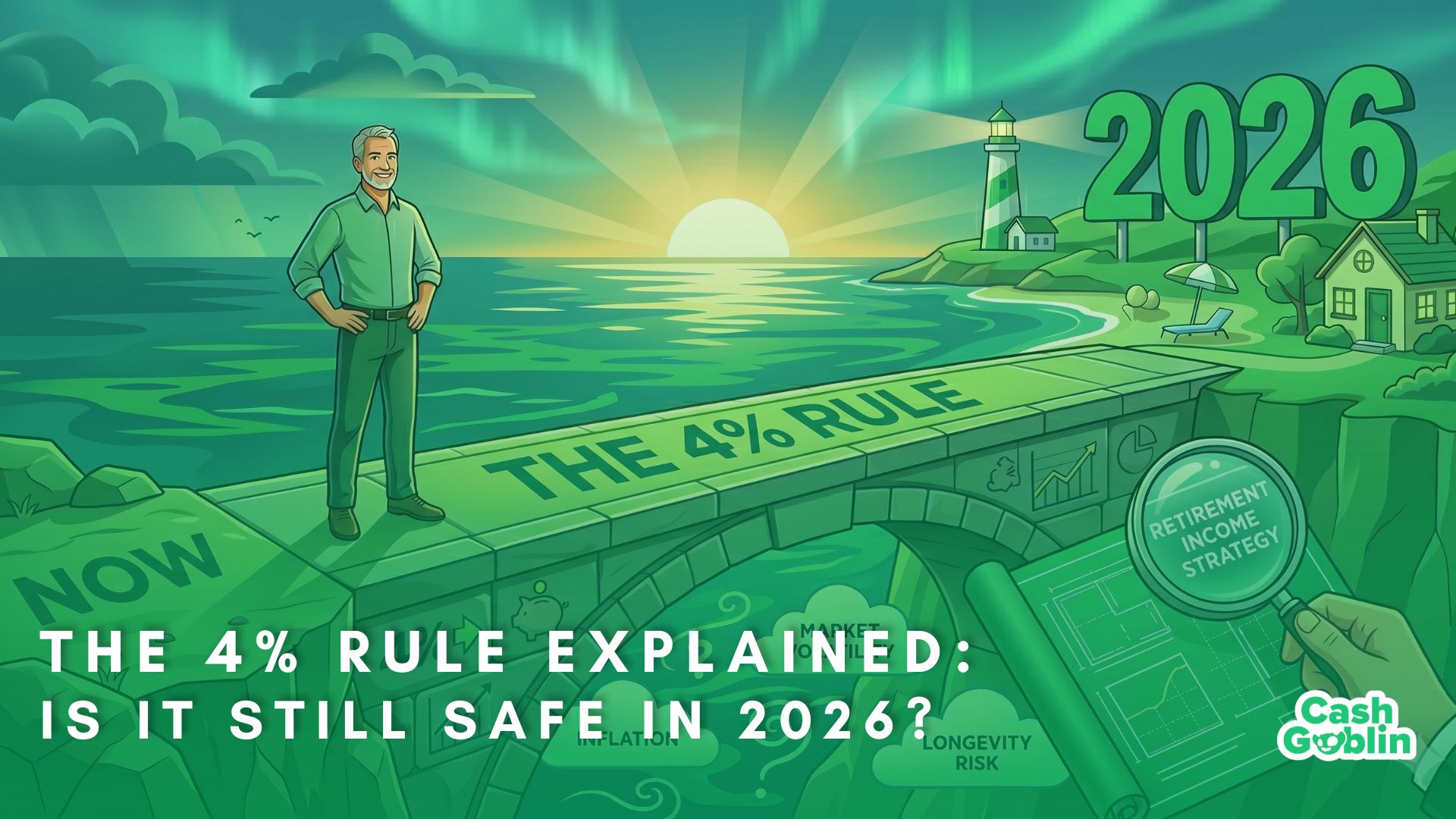
- No More Rigid Rules: The traditional 4% Rule isn't a sacred law; it's just a rough, old-school baseline that needs a friendly, modern update.
- Flexibility Wins: While stuffy banking guides warn you to cut your spending, modern research shows that being a little flexible actually lets you safely spend more.
- The Savings Hangover: Switching your brain from "saving mode" to "spending mode" is a massive psychological hurdle, and feeling anxious about it is completely normal.
- The Core Benefit: By ditching complex spreadsheets for a few simple, relaxed habits, you can retire with confidence, enjoy your money guilt-free, and stop worrying about every single penny.
If you are staring at your retirement savings with an unsettling feeling, take a deep breath. You are not alone, and you are not doing anything wrong.
We are living through a weird financial moment. The media shouts that you need a massive $1.46 million nest egg to retire, while half of the country has no formal savings at all. If you are aiming for early retirement, trying to figure out if you have "enough" can feel like playing chess with a blindfold.
Traditional financial advice doesn't help. It tells you to build rigid, hyper-optimized spreadsheets and live by strict mathematical formulas. But you are a human being, not an algorithm.
This post is your permission slip to let go of the spreadsheet stress. We are going to break down the famous 4% Rule in plain English, explain why the stuffy banking advice is making you anxious, and show you how to build a flexible, cozy system that keeps you safe without ruining your quality of life.
The Human Reality Behind the 4% Rule
Back in 1994, a financial planner named Bill Bengen wanted to answer a simple question: How much can someone safely pull from their savings each year without running out of money?
After looking at decades of market history, he proposed a simple guideline: if you have a balanced mix of stocks and bonds, you can safely take out 4% of your total savings in your very first year of retirement. For every year after that, you don't look at your portfolio balance—you just take that same starting dollar amount and add a little bit to keep up with the price of groceries.
For example, if you retire with $1 million, the rule says you take out $40,000 in Year One. If inflation goes up by 3% the next year, you take out $41,200 in Year Two. The "Multiply by 25" rule is just the reverse of this math: if you need $40,000 a year to live, you multiply that by 25 to get your $1 million goal.
Why the Traditional Advice Fails Humans
Stuffy financial companies love this rule because it is neat and tidy. But actual human lives are messy, beautiful, and completely unpredictable.
The 4% Rule assumes you will spend the exact same amount of money, adjusted only for inflation, every single year for three decades. But that's not how we live. Some years you’ll want to take a big trip, buy a "little treat," or help a family member. Other years, you’ll just want to stay home and read.
Worse, trying to force your life into a rigid formula ignores the real-world drag of taxes and fees, creating intense decision fatigue. It forces you to worry about worst-case market scenarios that will probably never happen. This is "toxic optimization"—it causes people to live like monks in their early retirement years, only to pass away with more money than they started with.
There is also a huge psychological barrier at play here: the "Ant vs. Grasshopper" dilemma. For thirty or forty years, you have trained your brain to be a diligent saver (the ant). When you finally retire, the financial world expects you to instantly flip a switch and become a spender (the grasshopper). Without a salary coming in, taking money out of your accounts triggers a literal stress response. Every withdrawal feels like you're losing your safety net.
The 2026 Vibe Check: Is 4% Still Safe?
If you talk to conservative planners today, they will tell you that because of high market prices and inflation, a completely rigid, unadjusting retirement portfolio is safer starting at 3.7% to 3.9%.
But here is the good news: you do not have to be rigid.
If you are willing to make small, stress-free adjustments along the way, modern research shows you can safely start with a withdrawal rate closer to 6%. Instead of hyper-focusing on every decimal point, you can adopt three simple, high-impact habits:
1. Use "Spending Lanes" (Guardrails)
Instead of sticking to a flat spending line, think of your retirement as driving in a comfortable lane. You start with a more generous withdrawal rate (like 5.2%) and set two simple boundaries :
- The Fast Lane (Upper Boundary): If the stock market goes on a massive run and your portfolio grows, you get a "raise" to fund memory-making experiences.
- The Slow Lane (Lower Boundary): If the market takes a temporary dip, you simply tap the brakes and trim your discretionary spending by 10%. This simple practice completely removes daily worry because you always know exactly where your boundaries are.
2. Embrace the "Skip-the-Raise" Hack
If the stock market has a bad year, you don't need to panic or completely rewrite your budget. You simply pause your annual inflation raise for that one year. Skipping just one or two inflation raises over a 30-year retirement dramatically protects your nest egg, allowing you to start with a higher safe withdrawal rate without any complicated math.
3. Ride the "Retirement Spending Smile"
Traditional calculators assume your spending will rise forever in a straight line. But real-world data shows that retiree spending naturally follows a "smile" shape: it starts high in your active, early retirement years, naturally drifts downward as you slow down, and only ticks up slightly at the very end for healthcare. Planning for this realistic spending decline—instead of a flat line—gives you permission to safely spend more while you are young and healthy.
Section 3: How to Build a Friendly "Retirement Paycheck"
To conquer withdrawal anxiety, you need to replace the scary feeling of "depleting your portfolio" with the comforting feeling of a regular salary. You can do this in three simple steps:
- Step 1: Create a Cozy Cash Buffer. Keep 2 to 3 years of basic living expenses in cash or short-term savings accounts. This is your "peace-of-mind fund." If the stock market drops, you don't have to sell your investments at a loss; you just live off your cash buffer.
- Step 2: Automate Your Paycheck. Set up an automatic monthly transfer from your cash buffer directly into your checking account. This simple trick makes your retirement feel like a normal, predictable salary, completely bypassing the monthly stress of manual withdrawals.
- Step 3: Lock in a Safe Floor. Coordinate your personal savings with guaranteed income. For instance, delaying Social Security claims toward age 70 is often the single most powerful way to maximize a guaranteed, inflation-proof monthly income floor.
Frequently Asked Questions
Does the 4% Rule include Social Security?
No. The 4% Rule only applies to withdrawals from your personal investment accounts. Any Social Security benefits, pensions, or side-hustle money you receive should be stacked on top as a comforting extra cushion.
What if the stock market crashes right after my retirement?
This is called "sequence of returns risk". You can easily protect yourself by keeping a 2-to-3-year cash buffer and using a flexible spending strategy - like skipping your annual inflation raise - during down years.
Is the 4% Rule safe for a very early retirement (40+ years)?
If you are retiring in your 40s or 50s, your money needs to last longer. In this case, starting with a slightly more conservative rate (around 3.3%) or using flexible "spending lanes" is highly recommended.
Do I really need 25 times my annual expenses to retire?
No, the 25x rule is just a rough benchmark. When you incorporate flexible spending habits, a cozy cash buffer, and future Social Security, you can often retire comfortably with less than that rigid target.
Bottom Line
At the end of the day, the 4% Rule is a helpful starting point - not a financial prison sentence. Financial wellness isn't about hyper-optimizing every single cent on a spreadsheet; it’s about building a flexible system that respects your humanity.
Your money is meant to fund your life, not just sit in an account to keep your anxiety at bay. Give yourself permission to step off the spreadsheet treadmill, embrace a little flexibility, and actually enjoy the freedom you worked so hard to build.
Ready to Build Your Worry-Free Retirement Paycheck?
Switching your brain from "saving mode" to "spending mode" is hard, but you don't have to guess your way through it. To safely run your "Spending Lanes" and manage your cash buffer without losing sleep, you need a clear, forward-looking map of your money.
Get immediate access to our 13-Week Cash Flow E-Course today. Learn how to build a simple, highly visual system that tracks exactly how your cash moves week-by-week, so you can automate your retirement paycheck and spend your hard-earned nest egg with 100% confidence and zero guilt.
GET INSTANT ACCESS TO THE 13-WEEK CASH FLOW E-COURSE HERE



.png)


.png)

.png)